Friday 11th September
This month marks nine years since I first recognised my DPDR symptoms as something I needed to acknowledge and look into. It was when derealisation first kicked in. I remember the exact moment it switched on, almost as though my brain had suddenly flipped into another mode. It felt like a new layer of defence had appeared to help me survive a life that, at the time, felt far too overwhelming. I didn’t understand what was happening, and without the language to describe it, the experience was terrifying.
As for depersonalisation, I think some part of me had always known that something wasn’t quite right. I had never really felt settled in my body or particularly confident in my identity. Mirrors made me uncomfortable, and even when I was very young, I was saying, “I don’t know who I am.” At the time, I had no idea that these experiences could be connected, and I certainly couldn’t have imagined that they would eventually lead me to a diagnosis of Depersonalisation Derealisation Disorder (DPDR).
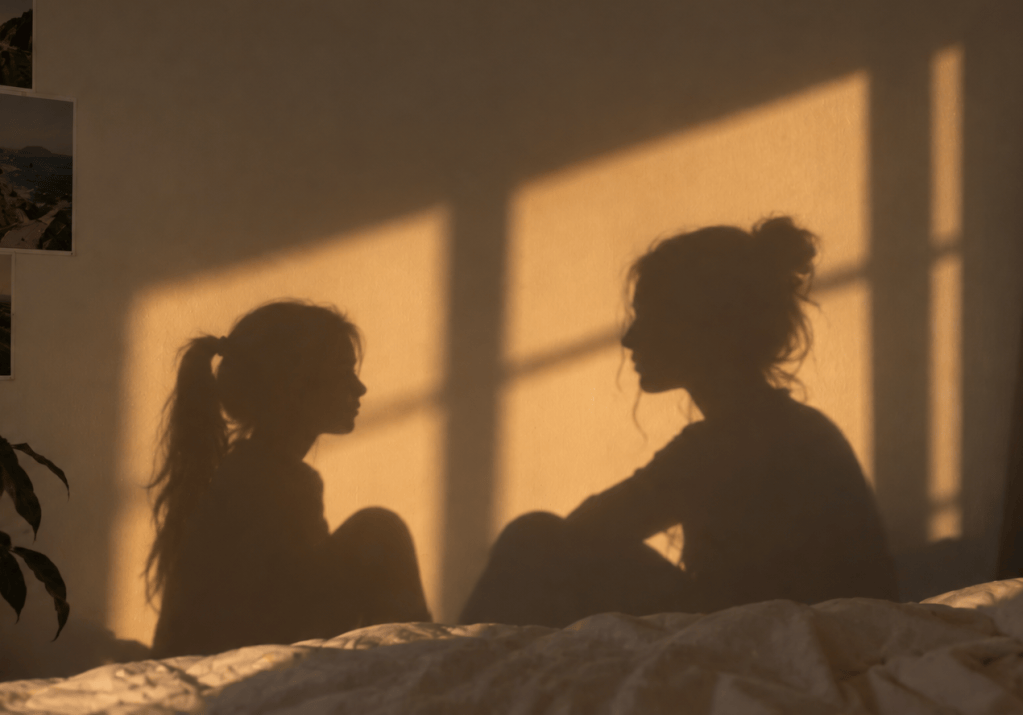
If I could go back and visit 15-year-old Kate, the girl who was so confused and so scared of her own reality, I think there is a lot I would want to tell her. Some of it would be about DPDR, but actually, most of it would probably be about life. I would want to give her the reassurance and perspective that can only really come from having lived through the years she hasn’t reached yet.
I would start by holding her. If I could be there in that room at the exact moment she felt that switch happen, I would hold her as tightly as I could and assure her that she was safe. I know that wouldn’t magically make the feeling disappear, but perhaps, for a moment, she wouldn’t feel quite so frightened by it. She wouldn’t have to sit there wondering whether she had finally lost her mind, because someone would be beside her saying, “I know this feels terrifying, but you are still here.”
I would encourage her to tell someone. I was in a situation where I was surrounded by some of the people closest to me, yet I felt completely alone inside my own head. I was so thrown off by what I was experiencing that I genuinely thought I was going crazy, and the fear of saying that out loud made everything even more isolating. Looking back, I wish I had known that I didn’t need to understand it before I was allowed to ask for help. I didn’t need a diagnosis, the right terminology or an explanation that made perfect sense. I could simply have said, “Something doesn’t feel right and I’m really scared.”
I would tell her that she isn’t alone, even though it will take her some time to realise that.The lack of general knowledge and understanding about dissociation is frustrating, and DPDR is an area that is still particularly misunderstood. For the person experiencing it, that means finding answers can take an enormous amount of time and effort. You can spend hours searching for an explanation for something that feels so fundamentally wrong, only to come away more frightened and confused than when you started.
Eventually, though, you will discover that there are other people who know exactly what you mean when you describe the world feeling unreal or your own body feeling unfamiliar. You will realise that what felt so uniquely terrifying to you is something other people have experienced too. Finding that community won’t take away everything you’re going through, but it will make it a lot less lonely.
I would also be honest with her about how difficult the next few years are going to be. There will be good days and bad days, periods of acceptance and understanding followed by periods of pure rage and confusion. There will be times when you feel grounded and connected to yourself, and others when you feel so spaced out that life doesn’t feel real for even a second. There will be moments when you think you’ve finally figured it all out, only to have a difficult day that makes you question whether you’ve made any progress at all.
I would want her to know that this doesn’t mean she’s going backwards. Progress is much less straightforward than she thinks it is. Sometimes it happens so gradually that you don’t notice it until you look back and realise that something which once controlled your entire life now occupies a much smaller space in it. A difficult day doesn’t erase the amount of work that came before it, and experiencing symptoms doesn’t mean that you have failed.
I’d tell her to stop comparing her life to everybody else’s. There will be so many moments over the next few years when you’ll look around and feel as though everyone else has figured life out. People will seem more confident, more settled and more certain about where they’re going, while you’ll wonder whether you’re somehow falling behind. You’ll compare relationships, careers, friendships, bodies, houses, holidays and achievements, convincing yourself that there must be some timeline you’re supposed to be following.
There isn’t.
You don’t have to know what you’re doing at 15, and you certainly don’t have to have your entire life mapped out by 20 or even 30, 40 or 50. You are allowed to change your mind about what you want, where you want to live, what you want to do for work and what you think you want your life to look like. Growing and changing your mind isn’t evidence that you are lost; it is one of the most normal parts of becoming an adult.
I’d probably have to warn her about relationships too. Some of the people you think will be in your life forever won’t be. There will be friendships that change and relationships that end, and there will be people you once couldn’t imagine living without who eventually become memories. Some of those endings will hurt more than you expect, particularly when you have invested so much of yourself into making something work.
But I would tell her not to measure the value of a relationship by how long it lasts. Some people are only supposed to be part of a particular chapter of your life, and that doesn’t make the chapter any less meaningful. You will meet people who teach you things about love, friendship and yourself that you couldn’t have learned any other way, and eventually you’ll understand that letting go of something that isn’t right for you isn’t the same as failing.
Most importantly, I would tell her not to abandon herself in an attempt to be loved. There will be times when you question whether you are too much, too complicated, too emotional or too difficult to love. Please don’t let those thoughts convince you that you need to make yourself smaller for somebody else. The people who genuinely belong in your life won’t require you to become somebody you’re not in order to keep them there, and you shouldn’t have to disappear parts of yourself just to make somebody comfortable.
I’d also tell her to be kinder to her body. I wish I could save my younger self from some of the time she spent looking at herself and seeing only things that needed changing. There will be years where you’ll compare yourself to other girls and convince yourself that you’ll finally feel confident once you look a certain way. Eventually, though, you’ll begin to appreciate your body for everything it allows you to experience rather than constantly judging it for how it looks.
Your body isn’t something you need to spend your life fighting with. It is the thing that has carried you through every difficult experience you’ve had, and it deserves considerably more kindness than you’ve given it.
I would tell her that she is going to do things that she currently thinks are impossible. This is one of my favourite things about looking back at younger versions of ourselves. We spend so much time worrying about the future without realising that the future contains experiences we can’t even imagine yet. Fifteen-year-old me couldn’t have pictured some of the places I’ve travelled, the people I’ve met, the things I’ve created or the person I’ve become.
And all of those things will happen while you still live with DPDR. I think that is something I would really want her to understand. You don’t have to wait until you feel completely better before you start living. For a long time, I believed that if I could just get rid of the DPDR, then everything else could begin. I’d travel when I felt better, feel confident when I felt better, enjoy life properly when I felt better and finally feel like myself when I felt better.
But there is no magical point at which you suddenly become completely fearless and perfectly comfortable in your own mind.
You can live while you’re healing. You can make memories while you’re struggling. You can fall in love, travel, laugh, make mistakes, try new things and build a life that matters to you even when part of you still feels disconnected.
In fact, some of the things you’re most proud of will happen because you decided not to wait. And, somehow, you’re going to do something really good with all of this.
You are going to start a blog. You’ll take something that once made you feel completely isolated and use it to start conversations with other people. You’ll encourage people to talk more openly about their mental health, and you’ll discover that sharing your own experiences can make somebody else feel a little less alone. You’ll watch conversations develop around a condition that you once couldn’t even find enough information about, and you’ll realise that your voice has a place within that conversation.
You won’t suddenly become grateful for everything you’ve been through, and I don’t think you need to be. Difficult experiences don’t become good simply because something positive eventually comes from them. But you can decide what you do with what happened to you, and you can use your experiences to create something meaningful.
You’re also going to work incredibly hard on yourself. Therapy will help you begin processing some of the things you’ve carried with you since you were tiny. You’ll learn things about yourself that you couldn’t have understood at 15, and you’ll slowly become more compassionate towards the parts of yourself you’ve spent years criticising. You’ll learn that giving yourself grace doesn’t mean making excuses; sometimes it simply means recognising that you’re doing the best you can with what you know at the time.
You’ll form incredibly beautiful relationships too. Someone will come into your life who sees parts of you that you struggle to see yourself, and you’ll learn what it feels like to be loved without having to constantly earn it.
And perhaps the biggest thing I would tell you is that DPDR isn’t going to control you forever. I wish I could explain exactly what that will look like, but the truth is that it won’t look like one morning waking up and suddenly being completely free from every strange sensation. Instead, it will happen in ways that are much quieter. You’ll begin doing things without thinking about whether DPDR is going to get in the way. You’ll have moments where you realise hours have passed without checking how real you feel. You’ll become more comfortable with the uncomfortable sensations instead of immediately assuming they mean something is wrong.
Eventually, DPDR won’t be the centre of your life. It might still walk beside you, but it won’t be deciding where you go. And I think that’s what I’d want 15-year-old Kate to understand most of all: your life is going to become so much bigger than this moment.
There are places you haven’t seen yet, people you haven’t met, friendships that haven’t happened and memories that you don’t even know you’re going to make. There are versions of yourself you haven’t met yet, and I wish I could give you a glimpse of all of them.
You’ll change your mind. You’ll make mistakes. You’ll lose people and find people. You’ll fall in love and have your heart broken. You’ll become stronger in ways you don’t expect, and you’ll still have moments where you feel completely unsure of yourself.
You will lose yourself a few times, and you’ll find yourself again.
So, please don’t be so afraid of the life ahead of you. You don’t need to understand everything that’s happening right now, and you don’t need to know how your story ends. Just keep going.
Because one day, you’ll look back at this version of yourself with so much love and realise that she was never broken. She was a scared little girl trying to make sense of something she didn’t understand, and she deserved compassion then just as much as she deserves it now.
All my Love, You x

