Tuesday 3rd February 2026
Not long ago, if you’d asked me what I thought about affirmations, I don’t think I would’ve dismissed them, I just wouldn’t have had much faith in them. The idea of repeating positive statements to myself felt… nice, but slightly abstract. Helpful in theory, maybe, but not something I imagined would make a meaningful difference.
And yet, over the past few months, affirmations have quietly become one of the most supportive tools in my day-to-day life.
This shift began while reading Feel the Fear and Do It Anyway by Susan Jeffers. It is beautifully written and incredibly impactful, not overwhelming or prescriptive, just practical and reassuring. One of the things Jeffers emphasises most is how we speak to ourselves, and how repetition can gently reshape the way we experience fear, confidence, and self-trust.
I think a lot of us associate affirmations with forced optimism or saying things we don’t believe yet. When you’re anxious, struggling with DPDR, or just feeling low, telling yourself “everything is fine” can feel wildly unrealistic. What changed things for me was realising that affirmations aren’t about pretending everything is perfect. They’re about offering your nervous system a different narrative. A kinder one. A steadier one. Something to hold onto when your mind is busy doing what it does best; worrying, overthinking, predicting worst-case scenarios.
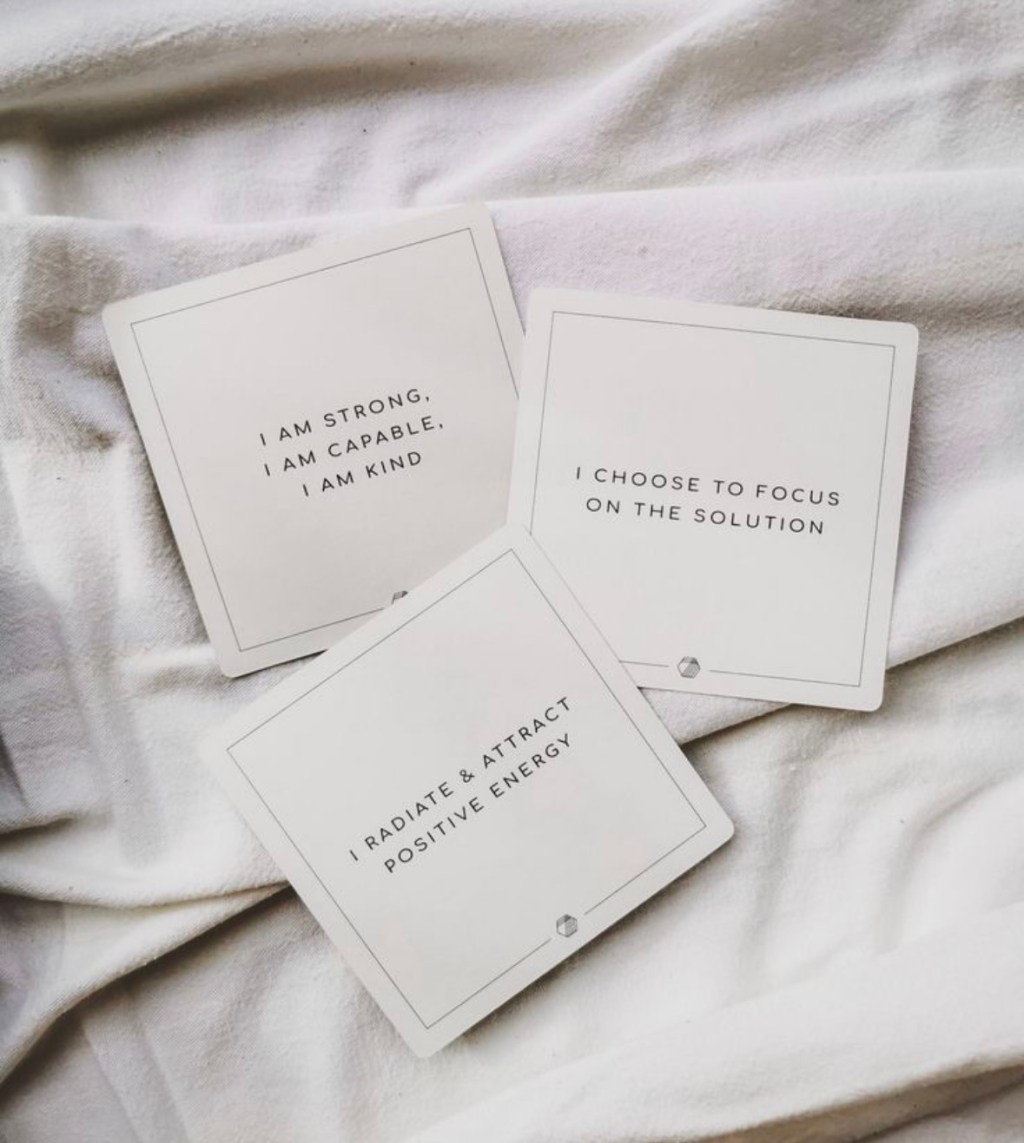
I’ve kept things very simple, taking inspiration directly from Susan Jeffers’ suggestions in the book. I listen to an affirmations playlist I created on Spotify compiled of audios made by Kinder Records. I put it on each morning and evening while getting ready, winding down, or when my mind feels noisy – times when I would usually put netflix on in the background as brain rot! I also bought a set of affirmation cards and stuck them around my mirror and desk. They’re constant, gentle reinforcements. Nothing dramatic. Just repeated reminders of safety, self-belief, and kindness.
But is there science behind it?…Of course!
Our brains are highly suggestible and pattern-driven. Through a process called neuroplasticity, the brain strengthens the pathways we use most often. The thoughts you repeat, especially emotionally charged ones, become familiar, automatic, and easier to return to. This is why negative self-talk is so dangerous. If you regularly tell yourself you’re failing, unsafe, behind, or not enough, your brain takes that information seriously. It doesn’t fact-check it. It just files it under “important” and keeps reinforcing it.
Affirmations work by doing the opposite.
When we repeatedly expose the brain to compassionate, grounding statements, we begin to form new pathways. At first, they may feel unfamiliar or even untrue. Over time, they become more accessible. They don’t eliminate fear or anxiety, but they soften it and offer an alternative voice when the critical one gets loud. Especially for anxious minds, affirmations can act like an anchor. A reminder that you are capable, safe enough in this moment, and allowed to take things one step at a time.
Living with DPDR means my inner world is often louder than my external one. When you don’t always feel present in your body or surroundings, your thoughts can feel like the only constant; the chatter, the questions, the looping conversations. Affirmations have helped me meet that internal noise with more gentleness. They don’t “fix” it, but they help me respond to it differently. They remind me that discomfort doesn’t mean danger, and that I can feel disconnected and still be okay.
So… cringey or life-changing? Maybe neither, or maybe both.
Affirmations haven’t changed my life overnight. But over the past few months, they’ve changed how I speak to myself. They’ve softened my inner dialogue, helped me feel steadier in moments of fear, and reminded me to be kinder when my mind is busy or overwhelmed.
And that feels like a meaningful shift.
Resources I’ve Been Using 🤍
- 📖 Feel the Fear and Do It Anyway – Susan Jeffers
[https://www.waterstones.com/book/feel-the-fear-and-do-it-anyway/susan-j-jeffers/9781785042652] - 🎧 Affirmations Playlist – Kinder Records (Spotify)
[https://www.waterstones.com/book/feel-the-fear-and-do-it-anyway/susan-j-jeffers/9781785042652] - 🪞 Affirmation Cards
[https://amzn.eu/d/arm3TuX]
If affirmations feel a little awkward or unfamiliar to you, that’s okay. I’d gently encourage you to try them anyway. Choose a few that resonate. Listen to them. Read them. Repeat them. Commit to them for a short while and allow yourself to believe, even just a little, that they could make a positive difference. You don’t have to feel convinced. You just have to be willing.
Sometimes the smallest shifts, repeated consistently, are the ones that change the most.
All my love, Kate x

 Mostly Kate